Is a Tankless Upgrade Worth It When Facing Local Water Quality Challenges?
Are you currently weighing the pros and cons of tankless vs. traditional water heaters: factoring in San Gabriel Valley’s hard water, or are you only looking at the energy efficiency ratings printed on the manufacturer’s box? When homeowners call our team at DrainFlow Solutions & Plumbing to start their upgrade journey, they are usually hoping to slash their utility bills and enjoy endless hot water. However, evaluating energy efficiency alone is insufficient without considering the long-term maintenance realities of the region you live in. The groundwater basins beneath the San Gabriel Valley naturally contain high levels of calcium carbonate, creating specific plumbing challenges that national buying guides often ignore.
Choosing between upgrading to a traditional tank or a modern tankless unit requires understanding exactly how local water chemistry interacts with heating elements over time. A high-efficiency appliance only remains efficient if its internal components stay clean and unobstructed. When mineral-heavy water meets intense heat, the resulting chemical reaction forces you to make a critical decision about your household’s maintenance tolerance. Whether you need comprehensive plumbing services or are ready to schedule a water heater installation, understanding local water chemistry is the first step toward making a lasting investment.
Understanding the Threat of High Calcium and Magnesium to Plumbing Appliances
To make an informed decision about your next appliance, you first need to understand the science of what hard water does to water heating equipment over time. The San Gabriel Valley relies heavily on local groundwater basins, which are classified as having “hard to very hard” water. This means the water flowing into your home carries a significant load of dissolved minerals, primarily calcium and magnesium.
While these minerals are perfectly safe for human consumption, they become highly problematic when subjected to rapid temperature changes. Inverse solubility is the scientific principle at play here: unlike sugar or salt, which dissolve faster in hot water, calcium and magnesium actually precipitate out of the water when heated. The moment your water heater activates, these dissolved minerals solidify, forming a hard, chalky white crust known as scale.
This mineral buildup acts as a powerful insulator. According to data from the Department of Energy (DOE) and the Water Quality Association (WQA), hard water scale can reduce the efficiency of water heaters by up to 24 percent over time if left unmanaged. The appliance is forced to work harder, burning more gas or drawing more electricity just to push heat through the thick layer of mineral rock before it can actually warm your water.
At DrainFlow Solutions & Plumbing, we look past generic national energy savings advice to provide honest local expertise based on years of hands-on fieldwork. In the San Gabriel Valley, scale management is not an optional maintenance task—it is a mandatory aspect of appliance ownership. Ignoring the regional water chemistry guarantees that any water heater, regardless of its design, will suffer a shortened lifespan and inflated operating costs.
The Vulnerability of Tankless Systems to Mineral Buildup
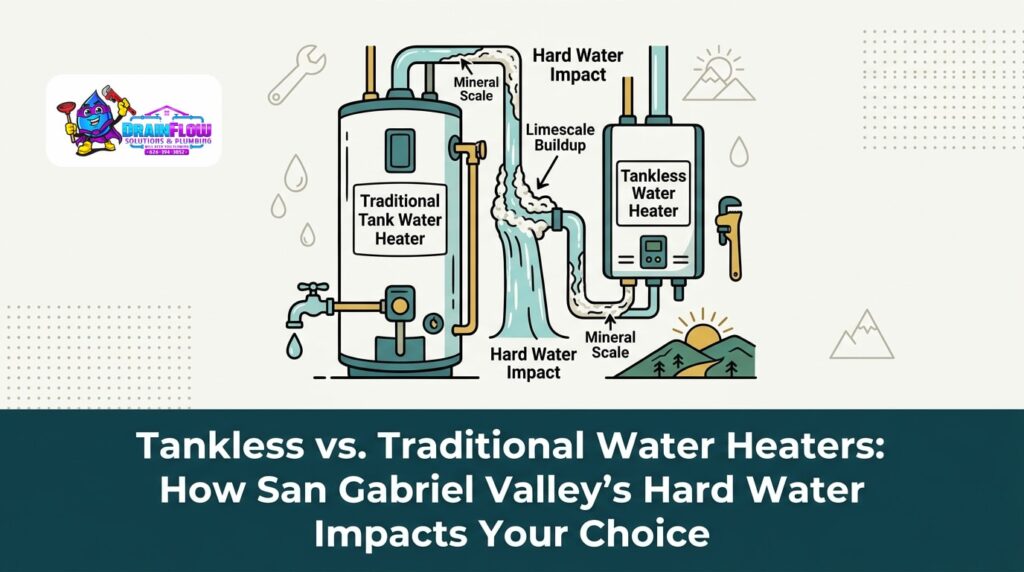
Modern tankless water heaters are engineering marvels, designed to provide endless hot water on demand while taking up a fraction of the space of a traditional unit. However, the specific mechanical design that makes them so efficient also makes them uniquely vulnerable to local water conditions. Tankless units operate using a series of extremely narrow pathways inside a component called a heat exchanger. When you open a hot water tap, flow sensors activate powerful burners that flash-heat the water as it weaves through this tight copper or stainless steel maze.
The Problem: This rapid flash-heating process is the perfect catalyst for scale formation. Because the internal pathways are so narrow, even a millimeter of scale can cause severe flow restriction. This specific consequence makes the unit highly susceptible to heavy mineral scaling on heat exchangers.
The Cause: As the San Gabriel Valley’s hard water boils through the heat exchanger, the calcium drops out of suspension rapidly. Because there is no large tank for the minerals to settle into, the scale bonds directly to the walls of the heat exchanger. Once heavy mineral scaling on heat exchangers begins, the unit’s sensors will detect the overheating. Modern systems are designed to protect themselves, so they will often display error codes and shut down entirely to prevent a catastrophic failure, leaving you with a sudden cold shower—a pattern our technicians see frequently on emergency calls.
The Solution: To combat this, manufacturer warranties almost universally require documented annual flushing to remain valid, especially in areas with known hard water. This maintenance involves a professional circulating a specialized descaling solution through the unit for an extended period to dissolve the heavy mineral scaling on heat exchangers. In our experience servicing the local area, households with exceptionally hard water and high usage may even require this rigorous descaling process every six to eight months to keep the unit operating efficiently and safely.
How Traditional Tank Water Heaters Handle Mineral Accumulation
Traditional tank water heaters react to the exact same hard water conditions in a fundamentally different way. Rather than forcing water through narrow, serpentine coils, a traditional system holds 40 to 50 gallons of water in a large, cylindrical steel reservoir. Heat is applied either via a gas burner located beneath the tank or electric heating elements protruding directly into the water.
Because traditional tanks have a massive surface area at the bottom, they handle the precipitation of calcium and magnesium differently. When the minerals solidify, gravity pulls them downward. The scale and sediment naturally settle at the base of the tank. While a tankless unit suffers from immediate flow restrictions due to heavy mineral scaling on heat exchangers, a traditional tank simply accumulates a growing layer of rock at its bottom.
You can often hear the symptoms of this sediment layer long before the unit fails. On our routine maintenance visits, we frequently point out to homeowners that if your current tank sounds like a percolating coffee pot, you are hearing the direct result of unmanaged hard water. As the burner heats the bottom of the tank, the water trapped beneath the layer of mineral sediment begins to boil. The resulting bubbles force their way up through the rock, creating distinct popping, rumbling, or knocking noises.
While tanks do not suffer from the same immediate shutdown triggers as tankless units, neglecting their maintenance still exacts a heavy toll. The sediment layer acts as a barrier, forcing the burner to run longer and hotter. This overheating weakens the steel floor of the tank, eventually leading to stress fractures, leaks, and the need for professional water heater repair or total replacement. Tanks require annual maintenance as well, but the process involves draining the bottom sediment rather than performing a chemical flush of a narrow heat exchanger.
Side-by-Side Comparison: Tank vs. Tankless Maintenance Realities
To provide a clear, objective breakdown of how local water chemistry impacts both plumbing systems, we need to compare them directly. The following table illustrates the realistic decision framework we use when helping homeowners in the San Gabriel Valley weigh these two options.
| System Feature | Tankless Water Heater | Traditional Tank Water Heater |
|---|---|---|
| Energy Efficiency | High efficiency and endless hot water, but only if kept entirely scale-free. | Lower efficiency due to standby heat loss, but less sensitive to immediate flow restriction. |
| Maintenance Frequency | Mandatory, rigorous annual (or bi-annual) chemical descaling required. | Annual flushing of the bottom valve to remove loose sediment. |
| Hard Water Vulnerability | Heavy mineral scaling on heat exchangers causes immediate error codes and shutdowns. | Sediment builds up at the bottom, slowly reducing efficiency and causing rumbling noises. |
| Space Requirements | Wall-mounted design frees up significant floor space in garages or closets. | Requires a dedicated, large footprint and specific vertical clearances. |
| Expected Lifespan | Can last 20+ years if meticulously maintained and protected from scale. | Typically lasts 10-15 years before the tank floor rusts or fractures. |
Key takeaways our team emphasizes for local homeowners:
- The efficiency trade-off: A tankless system will absolutely lower your energy consumption, but that savings must be weighed against the cost of mandatory annual descaling.
- Warranty protection: Manufacturers track maintenance. If a tankless unit fails due to heavy mineral scaling on heat exchangers and you cannot prove annual maintenance, the warranty claim is typically denied.
- Lifespan variables: Both systems boast impressive lifespans on paper, but those estimates drop significantly if the San Gabriel Valley’s hard water is ignored.
- Space vs. Simplicity: If freeing up garage space is your primary goal, tankless is the clear winner, provided you commit to the upkeep schedule.

Protecting Your Investment: The Role of Water Treatment
If you decide that the endless hot water and space-saving benefits of a tankless unit are right for your home, introducing a mitigation strategy is a necessary next step. We always remind our customers that pairing tankless upgrades with whole-home water treatment is a crucial factor in calculating the true total cost of ownership.
The most effective way to protect a modern water heater is to address the problem before the water ever reaches the appliance. By installing a water softener system, you actively remove the calcium and magnesium ions from your water supply, exchanging them for harmless sodium or potassium ions. Because the hard minerals are physically extracted from the water, they cannot precipitate out during the flash-heating process. This completely prevents heavy mineral scaling on heat exchangers.
Our goal at DrainFlow Solutions & Plumbing is to provide honest advice on true maintenance requirements rather than just delivering a generic sales pitch for tankless efficiency. The reality we see in the field is that pairing a tankless unit with a water softener is the only guaranteed way to protect the manufacturer’s warranty and ensure the appliance achieves its promised 20-year lifespan and peak energy efficiency. While traditional tanks also benefit immensely from softened water—running quieter and lasting longer—water softening is often considered a critical, non-negotiable requirement for tankless longevity in this specific region.
Frequently Asked Questions About Water Heaters and Local Water Quality
Do tankless water heaters get calcium buildup?
Yes, they are highly susceptible to it. Because tankless units use narrow pathways to flash-heat water on demand, the rapid temperature change causes dissolved minerals to precipitate quickly. This leads directly to heavy mineral scaling on heat exchangers if the water is not treated or the unit is not professionally flushed regularly.
Is a tankless water heater better if you have hard water?
It is not necessarily better or worse, but it requires much more precise and rigorous maintenance. A traditional tank can temporarily tolerate a layer of sediment at its bottom, whereas a tankless unit will suffer immediate flow restrictions and error codes. Without treatment, heavy mineral scaling on heat exchangers will quickly reduce a tankless unit’s efficiency and trigger safety shutdowns.
How often should you flush a tankless water heater with hard water?
Most manufacturers require at least annual flushing to keep the internal components clean and the warranty valid. However, in areas with very hard water like the San Gabriel Valley, our plumbers typically recommend more frequent professional maintenance—sometimes every six to eight months—to dissolve stubborn scale and maintain optimal performance.
Do I need a water softener with a tankless water heater?
While not legally required by building codes, it is highly recommended by virtually all plumbing professionals and manufacturers. Installing a water softener is the most effective way to prevent scale from forming in the first place, protecting the significant financial investment you made in the tankless upgrade.
How does hard water affect the lifespan of a traditional tank?
Hard water causes mineral sediment to build up at the bottom of the tank, which acts as a thick layer of insulation between the heat source and the water. This forces the burner to run longer and hotter, causing the steel tank to overheat, weaken, and eventually develop premature leaks if the sediment is not drained annually.
Make an Informed Decision for Your Next Water Heater Upgrade
Upgrading your home’s hot water system is a significant decision that impacts your daily comfort and your monthly utility bills for a decade or more. The choice requires carefully balancing the high energy efficiency and endless supply of tankless units against their strict, mandatory maintenance needs in hard water environments. Conversely, traditional tanks offer a more forgiving maintenance schedule but lack the space-saving design and long-term energy optimization of their modern counterparts.
A clear, objective breakdown of how local water impacts both systems provides the best foundation for a lasting upgrade. Because the San Gabriel Valley presents unique water quality challenges, the smartest approach is to evaluate your household’s specific hot water demand, available space, and willingness to commit to annual maintenance. Reach out to our experienced team at DrainFlow Solutions & Plumbing to properly assess your home’s plumbing infrastructure and water hardness level. Schedule an evaluation today to ensure your next water heater delivers reliable performance without unexpected maintenance surprises.