The Myth of the Winter Pipe Burst: Why Pipes Burst in Mild Climates: Pressure Spikes and Aging Infrastructure Explained
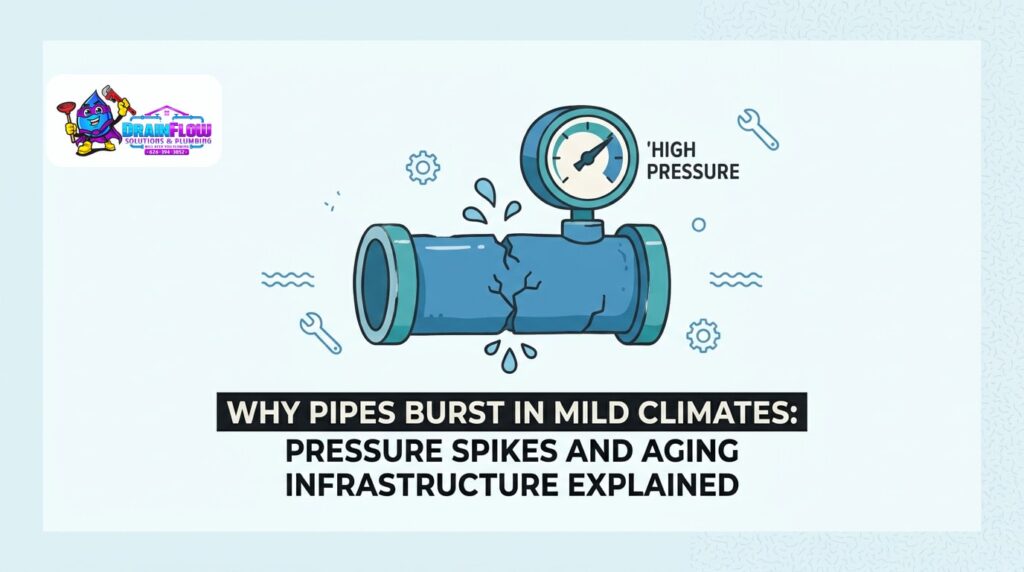
Wrapping exposed outdoor lines in foam insulation and leaving indoor faucets dripping overnight are rituals most homeowners associate with preventing a plumbing disaster. The common misconception is that sub-zero freezing temperatures are the only force powerful enough to rupture a solid metal or thick plastic water line. Understanding Why Pipes Burst in Mild Climates: Pressure Spikes and Aging Infrastructure Explained reveals a completely different reality. The truth is that catastrophic plumbing failures frequently occur during mild weather months, driven by invisible, silent forces that never make the evening weather forecast.
If you are dealing with unexpected structural leaks or system stress, securing professional plumbing services is the most effective way to protect your property from hidden damage. At DrainFlow Solutions & Plumbing, our team frequently responds to these unexplained mild-weather blowouts throughout the local area, and we can tell you firsthand that hidden pressure is usually the culprit.
When you eliminate freezing as the primary culprit, you are left with the true drivers of residential plumbing blowouts in frost-free zones. Unchecked municipal water pressure and the natural, unavoidable fatigue of aging pipe materials work together to weaken your system from the inside out. Homeowners often focus entirely on the external temperature, ignoring the massive hydrostatic forces pushing against the interior walls of their pipes every single second of the day. Here is how these invisible stressors operate and why they require proactive attention.
The Mechanics of Non-Freezing Ruptures
To understand how a pipe fails without ice, you have to look at the physics of water delivery. Water is heavy, incompressible, and relentless. When it is forced through a closed network of pipes, it seeks the path of least resistance. In a healthy plumbing system, that path is an open faucet or a flushing toilet. In a compromised system, that path becomes a microscopic weak point in a copper joint or a hairline fracture in an aging supply line. During mild weather months, the absence of a dramatic freeze lulls homeowners into a false sense of security, allowing these internal pressures to build unnoticed until the material finally gives way.
The Silent Threat of High Municipal Water Pressure
Municipal water delivery is an incredible feat of modern engineering, but it comes with inherent risks to residential properties. To move millions of gallons of water across vast distances, up steep hills, and into towering structures, city water purveyors must pump water at incredibly high pressures. The varied topography of many regions means that water leaving a municipal pumping station or gravity-fed reservoir might be traveling at well over 100 or even 150 pounds per square inch (PSI) by the time it reaches street-level distribution mains.
Because these street-level pressures are dangerously high for interior fixtures, the Uniform Plumbing Code (UPC) specifically requires mechanical regulation whenever municipal lines deliver water pressure exceeding 80 PSI. Without this regulation, that massive municipal force transfers directly into your home’s delicate network of supply lines, appliance hoses, and fixture valves.
When sudden municipal pressure spikes occur—often unannounced and late at night when neighborhood water usage drops—the stress on your system multiplies. If you suspect your home is bearing the brunt of unregulated city water, scheduling professional pipe repair and replacement or pressure diagnostic services is an urgent priority. In our experience, many homeowners do not realize their home is under duress until a spike causes a middle-of-the-night rupture.
How Topography and Infrastructure Impact Your Home
Your home’s location on the municipal grid plays a massive role in the baseline pressure your plumbing endures. Homes located at the bottom of steep hills or in deep valleys often receive significantly higher pressure due to gravity compounding the municipal pump force.
| Location on Municipal Grid | Expected Street-Level Pressure | Risk to Residential Plumbing |
|---|---|---|
| High Elevation / Top of Hill | Lower (40 – 60 PSI) | Low risk of pressure bursts; potential low-flow complaints. |
| Mid-Level / Flat Terrain | Moderate (60 – 90 PSI) | Moderate risk; regulation strongly recommended for stability. |
| Low Elevation / Valley Floor | High (90 – 150+ PSI) | Severe risk; functional mechanical regulation is absolutely mandatory. |
Constant high pressure acts as a relentless stressor. It forces joints to bear loads they were never designed to hold, wears down the rubber gaskets inside your fixtures, and turns flexible supply lines into ticking time bombs. Because municipal pressure spikes are entirely out of your control, the defense mechanism must live entirely within your property line.

Why Pressure Reducing Valves (PRVs) Fail Unnoticed
The home’s primary, and often only, defense against aggressive municipal water delivery is the Pressure Reducing Valve (PRV). Installed on the main water line just after the meter or shut-off valve, this bell-shaped brass device acts as a mechanical gatekeeper. Its job is to take incoming water pressure exceeding 80 PSI and step it down to a safe, manageable flow—typically between 50 and 70 PSI—before it enters your home.
The internal mechanics of a PRV rely on a heavy-duty spring and a flexible rubber diaphragm. As water enters the valve, it pushes against the diaphragm, which is counterbalanced by the tension of the spring. This delicate balancing act restricts the physical opening the water can pass through, thereby reducing the pressure on the other side. However, these moving parts are subjected to constant friction, chemical wear from municipal water treatment, and standard material degradation.
Because of this constant workload, PRVs do not last forever. They have a standard lifespan of 10 to 15 years. The danger lies in how they fail. When the internal diaphragm tears or the spring loses its tension, the valve usually fails in the “open” position. This is a silent failure. Water continues to flow to your sinks and showers, but it is now entering your home at the dangerous, unregulated street pressure.
The Diagnostic Process
Homeowners rarely notice a PRV failure until a secondary component—like a toilet fill valve or a washing machine hose—gives out under the strain. Testing and verifying the health of a pressure regulator requires professional diagnostic tools. Plumbers do not just check the static pressure; they test the dynamic pressure while water is flowing to see how the valve reacts under a load. If your home is over a decade old and you have never had the regulator checked, scheduling a comprehensive plumbing inspection is a critical maintenance step to prevent a sudden blowout. Our technicians use specialized load-testing gauges to verify dynamic pressure and ensure your PRV is actually doing its job.
Material Fatigue: When Aging Infrastructure Meets Modern Flow
While high pressure is the catalyst, the condition of the pipes themselves dictates whether they will survive the stress. Older homes often feature legacy plumbing materials that were installed long before modern flow requirements and water treatment chemicals became the standard. Materials like clay, cast iron, galvanized steel, and aging thin-walled copper each have their own unique degradation timelines.
Material fatigue is the slow, progressive weakening of a pipe’s structural integrity. Every time a faucet is turned on and off, the sudden change in water flow causes microscopic expansion and contraction in the pipe walls. Over decades, this constant flexing, combined with the scouring action of water and the corrosive nature of dissolved minerals, thins the metal or makes the plastic brittle. When a failed PRV suddenly allows modern municipal pressure to slam into severely fatigued older pipes, the material simply cannot hold the line.
This dynamic is especially relevant in Southern California. In this constantly mild climate, the focus on winterizing is virtually non-existent. Instead, aging infrastructure degrades steadily and quietly without the dramatic catalyst of a freeze. Homeowners are often caught off guard when a pipe bursts during mild weather months, assuming their plumbing was safe simply because it wasn’t cold outside.
The Vulnerability of Legacy Materials
Different materials respond to material fatigue in different ways, but the end result of unchecked pressure is always a breach in the system.
- Galvanized Steel: Rusts from the inside out, creating uneven internal surfaces that restrict flow and create high-pressure friction points.
- Aging Copper: Susceptible to “pitting” corrosion from aggressive water chemistry, leaving the pipe walls paper-thin and highly vulnerable to pressure blowouts.
- Clay and Cast Iron: While mostly used for sewer lines, these materials become incredibly brittle over time. The ground shifts, the material cracks, and roots intrude. If you are dealing with these specific legacy materials underground, exploring trenchless sewer repair for clay pipes is the modern standard for restoration.
The combination of advanced material age and unregulated water pressure is the primary driver of sudden, catastrophic leaks in regions that never see a snowflake.
Thermal Expansion in Frost-Free Zones
There is another physical force that causes pipes to burst without freezing temperatures: thermal expansion. This phenomenon occurs entirely within the walls of your home and is directly tied to how your water heating system interacts with your overall plumbing network.
When cold water enters your water heater, the burner or heating elements activate to bring that water up to the set temperature (usually around 120°F). As water heats up, its volume physically expands. In an open plumbing system, this expanding water would simply push back out into the municipal supply line, dissipating the pressure. However, modern plumbing codes require PRVs or check valves to prevent backflow into the city supply, creating what is known as a “closed plumbing system.”
In a closed system, that expanding heated water has nowhere to go. If the home is not equipped with a functioning thermal expansion tank—a small tank with an internal air bladder designed to absorb this extra volume—the pressure inside the home’s pipes skyrockets every time the water heater runs. This internal pressure can easily exceed the safety ratings of the pipes, even if the incoming municipal pressure is perfectly regulated.
The Impact of Consistent Warm Weather
In constantly mild, frost-free climates, thermal expansion is a year-round reality that demands proper pressure management. Furthermore, consistent warm weather can actually exacerbate baseline pressure issues. When the ground temperature remains warm, the incoming municipal water is slightly warmer, which changes how it interacts with the water heater’s recovery cycle. Thermal expansion acts as a secondary, compounding factor that pushes already stressed, fatigued pipes past their breaking point, causing ruptures that seem entirely unprovoked to the untrained eye.
Warning Signs Your Plumbing System is Under Stress
Catastrophic pipe bursts rarely happen without warning. The plumbing system usually sends out distress signals for weeks or months before a pipe wall completely fails. Recognizing these symptoms early allows you to address the pressure issue before you are forced to deal with extensive water damage and mold remediation.
Because diagnosing pressure issues requires specialized gauges and an understanding of fluid dynamics, these are non-DIY symptoms. If you notice any of the following indicators, it is time to call in a professional for comprehensive leak detection and repair.
- Severe Water Hammer: This is a loud, aggressive banging or thudding noise that echoes through the walls immediately after you turn off a faucet or when a washing machine valve snaps shut. Water hammer is the physical shockwave of fast-moving, high-pressure water slamming into a closed valve. It is one of the most reliable indicators that your PRV has failed.
- Spitting or Aggressive Aerators: If water blasts out of your bathroom or kitchen faucets with enough force to splash out of the sink, the pressure is too high. A healthy flow should be steady and controlled.
- Constantly Running Toilets: The delicate fill valves inside toilet tanks are highly sensitive to pressure. If they are constantly running or leaking water into the overflow tube, high pressure is likely forcing water past the internal seals.
- Premature Appliance Failure: Washing machines, dishwashers, and ice makers have internal solenoid valves rated for standard pressure. If these appliances are leaking or requiring frequent repairs, the incoming water pressure is likely tearing them apart.
- Random, Disconnected Leaks: If a faucet cartridge leaks on Monday, a showerhead drips on Wednesday, and a supply line weeps on Friday, you do not have three isolated part failures. You have a central pressure issue that is finding the weakest links across the entire system.
Ignoring these signs is a dangerous gamble. They are the precursors to a full-scale pipe burst that can flood a home in minutes.
Addressing Root Causes Over Surface Leaks
When a pipe bursts or a pinhole leak develops, the immediate instinct is to patch the hole or replace that specific section of pipe. While stopping the active leak is the first priority, merely patching a surface leak without testing the home’s overall incoming water pressure is a recipe for a repeat disaster. If the root cause is a failed regulator delivering 120 PSI to the home, patching one weak spot simply forces that extreme pressure to find the next weakest joint in the line.
Comprehensive diagnostics identify the true root cause of the failure. As diagnostic experts at DrainFlow Solutions & Plumbing, we look beyond the immediate puddle on the floor. We evaluate the age of the infrastructure, test the dynamic function of the PRV, assess the presence of thermal expansion, and inspect the integrity of the surrounding materials. This holistic approach ensures that when a repair is made, it actually stabilizes the home for the long term.
Modern Solutions for Systemic Failures
Once the pressure issue is resolved—typically by installing a new, high-quality pressure reducing valve and an expansion tank—the compromised pipes can be addressed. If material fatigue has compromised an entire underground line, modern minimally invasive repair methods can replace the failing infrastructure without destroying the property. Techniques like pipe bursting allow technicians to pull a brand-new, high-density polyethylene (HDPE) pipe through the path of the old, degraded line, providing a permanent solution to material fatigue once the pressure environment has been safely regulated.
Frequently Asked Questions About Non-Freezing Pipe Bursts
What causes pipes to burst without freezing?
High municipal water pressure and material fatigue are the primary causes of non-freezing pipe bursts. When a home’s pressure reducing valve (PRV) fails, unregulated street pressure slams into aging pipes, causing them to rupture. Secondary factors include severe water hammer, thermal expansion in closed systems, and shifting soil that physically breaks underground lines.
How do you check for high water pressure in a house?
You can identify high water pressure by listening for loud banging noises behind the walls (water hammer) or watching for aggressive, splashing flow at your faucets. However, the only way to get an exact measurement is for a professional to attach a specialized pressure gauge to an exterior hose bib. This allows them to test both the static resting pressure and the dynamic working pressure of the system.
What are the signs of a failing pressure reducing valve?
A failing pressure reducing valve often presents as a sudden, inexplicable increase in water pressure across all fixtures in the home. You might also notice inconsistent flow rates, toilets that run constantly because the internal valves are overwhelmed, or a humming and vibrating noise coming directly from the main water line where the PRV is installed.
Can hot weather cause pipes to burst?
While ambient heat itself does not directly burst pipes, consistent warm weather contributes heavily to thermal expansion within a home’s closed plumbing system. As water heats up and expands in the water heater, the resulting internal pressure spikes can over-pressurize older, weakened pipes, eventually pushing them to the bursting point during the summer months.
How long do pressure reducing valves typically last?
Most residential pressure reducing valves have a functional lifespan of 10 to 15 years. Over time, the heavy-duty internal rubber diaphragm degrades and the tension spring weakens due to constant friction and water chemistry. Because they usually fail silently in the open position, proactive replacement around the 12-year mark is highly recommended.
Safeguard Your Plumbing Against Pressure Spikes
Understanding the invisible dynamics of your home’s water supply is the key to preventing unexpected plumbing disasters. When you recognize that water pressure exceeding 80 PSI acts as a constant, destructive force against aging materials, the myth of the winter pipe burst fades away. Recognizing the early symptoms of system stress—like water hammer and aggressive flow—can save your property from extensive, costly water damage. Do not wait for a fatigued pipe to fail entirely; have your water pressure professionally tested and your aging infrastructure evaluated to ensure your home remains safe, dry, and fully functional year-round.